
































USA, November 18th, 2026 — Peakflo organized a live session at the Finance & Accounting Technology Expo (FATE) in New York, featuring:
- Saurabh Chauhan, Co-founder and Chief Executive Officer at Peakflo
- Dmitry Vedenyapin, Co-founder and Chief Technology Officer at Peakflo
Our esteemed speakers delved into the pressing topic of “Ask Your ERP Data What to Automate Next”. Finance teams have years of data sitting in their ERP systems. Very few use it to decide what to fix next.
Why AI pilots stall
About 95% of AI pilots running in organizations fail to show measurable results within 90 days of kickoff. Many of those pilots never become full-time programs and fade out at the proof-of-concept stage.
The cause, Dmitry argued, is where teams put their effort. “Everyone is focusing on the third layer, orchestration, while skipping the foundations,” he said. Teams build an impressive agent first, then find it cannot reach the right systems, does not understand the business, and has no way to prove it worked.
The Peakflo team saw this pattern again and again while implementing automations, so they built a framework around the foundations instead.
The Agentic Leverage Stack
Peakflo calls its framework the Agentic Leverage Stack: the common layers behind AI projects that succeed. The agent doing the orchestration is only one of them.
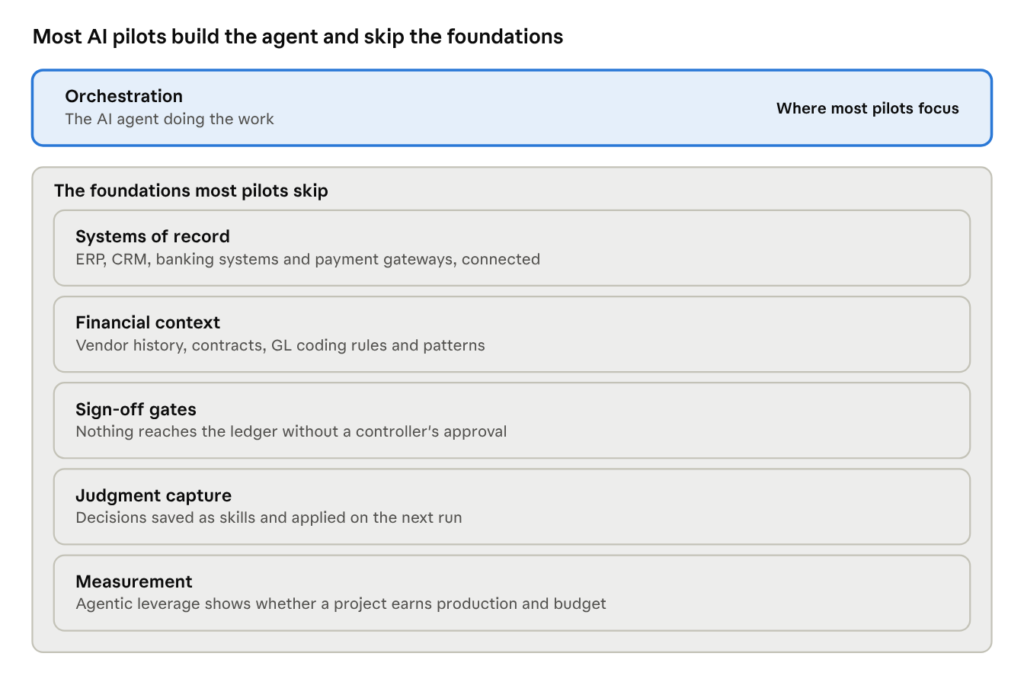
In practice, the agent shouldn’t look at an invoice alone. It should see the vendor’s history, the contract, and your GL coding rules, and nothing should reach the ledger without a controller’s sign-off.
Where to start?
The most common question the team hears is simple: how do we start with AI? Their answer is that your ERP already knows.
Your system of record holds every transaction, journal, reversal and approval. It shows how long your team takes to close the month and the year. Pull that data, and the top automation opportunities for your company become visible, without a quarter-long consulting assessment.
In the demo, an AI agent connected to a NetSuite instance and read 24 months of history: around 90,000 transactions, plus journals, vendor master data and GL accounts. It then ran a diagnostic to find the biggest time sinks, benchmarked against companies in the same industry. A manufacturer, a logistics company and a retailer each get a different benchmark.
For the example company, the diagnostic surfaced three problems:
| Time sink | This company | Industry benchmark |
|---|---|---|
| Month-end close | 15 days | 3 days |
| Bill approvals | About 7 days | About a third of that |
| Journal entries needing manual reclassification | 34% | Not stated |
This is the first step with every client, Saurabh explained: connect to the systems of record, then let the data show where a finance team will see the highest return first.
Fixing a 15-day close
With month-end close flagged as the biggest time sink, Saurabh created a Peakflo Space to tackle it, live on stage. The example company was a retailer, so the agent worked across point-of-sale data, Square payments, a NetCash bank feed and NetSuite.
- Connect the systems of record. The month-end close template suggested the systems this retailer needed: NetSuite, Square, the NetCash bank feed, Gmail or Outlook, and spreadsheets, where a lot of finance knowledge still lives.
- Give it instructions. A plain-language brief: download statements from Square, match them to the point-of-sale system at order-ID level and to NetSuite banking, run the reconciliation reports, and flag exceptions to the right people.
- Bring in the right people. GL approvers for liabilities or expense categories, and exception handlers, such as someone for fixed assets. The agent now knows who to ask about each kind of exception.
- Run the reconciliation. The agent pulled the sales and payment gateway reports and the bank feed, then ran a three-way match across 10,000 transactions for the month. Clear matches were closed; the rest were surfaced as exceptions.
- Resolve exceptions in conversation. The agent opened a chat and walked through each exception. It suggested one was a split payment from a customer, and the user confirmed. It flagged a 2.9% card fee where Square usually charges 2.5%; the user explained it was likely a premium card such as Amex, and the agent reconciled it as an anomaly.
- Escalate what rules can’t solve. A $200 discrepancy didn’t fit any predefined rule. The agent messaged the outlet manager, the finance cash tracker and the controller in Microsoft Teams or Slack. The outlet manager attached a PDF showing a $200 refund, a colleague confirmed the refund was missing from the tracker, and the controller approved the adjustment.
- Post with sign-off. The agent built the journal entries and sent a consolidated summary to the controller, who can review every data point, request changes, or approve. Only then does the agent post to NetSuite.
Every approval is recorded in an audit trail, so every agent decision is on record. The same approach works beyond the close: Spaces can be built for collections, procure-to-pay and revenue recognition, depending on what the diagnostic finds.
Every fix becomes a skill
After the $200 refund was resolved, the agent did one more thing: it saved the decision as a skill. The rule reads, in effect: a cash gap of this type, within this limit, is pre-approved by the controller. Next time, the agent skips the conversation, creates the adjustment and sends it straight to the approver.
These skills keep updating with every interaction. Saurabh described the result as “an intelligent new hire in your team” that understands more financial context the more it works with you. It also keeps your team from feeling like they’re dealing with a bot that asks the same questions again and again.
Capturing judgment this way has a second benefit: it keeps the AI from hallucinating and makes outcomes as deterministic as possible.
Measuring success: agentic leverage
For simple use cases, accuracy is a good enough measure. But once agents run multi-step loops, accuracy alone no longer tells you whether a project is worth keeping. So the team introduced a new metric, agentic leverage:
Agentic leverage = hours of accepted agent work / hours your team spends reviewing and correcting the AITwo rules make the number honest. Count only agent work your team accepted. And measure human review time rather than estimating it.
Without a measure like this, Dmitry pointed out, you can’t decide whether a project should go into production, or whether it deserves budget next quarter.
You stay in control
The AI recommends which Spaces to build first, based on the time sinks it finds in your ERP data, and hands you a template to start from. But the priorities are yours. You decide what to tackle, who signs off, and what gets posted to your ledger.
The lesson from FATE is that AI projects in finance succeed when they are built on solid foundations: connected systems, real financial context, sign-off gates, captured judgment and honest measurement. Start with the data you already have.
Want to know where your finance team is losing the most time? Book a free diagnostic of your ERP data with Peakflo.